Retail Copilot Agent: Local AI Insights via LangGraph & SQL
Privacy-first retail analytics copilot that answers questions about your database and policy documents using hybrid RAG + SQL. Built with LangGraph (7-node workflow) and optimized with DSPy — boosting valid SQL rate from 40% to 80%.
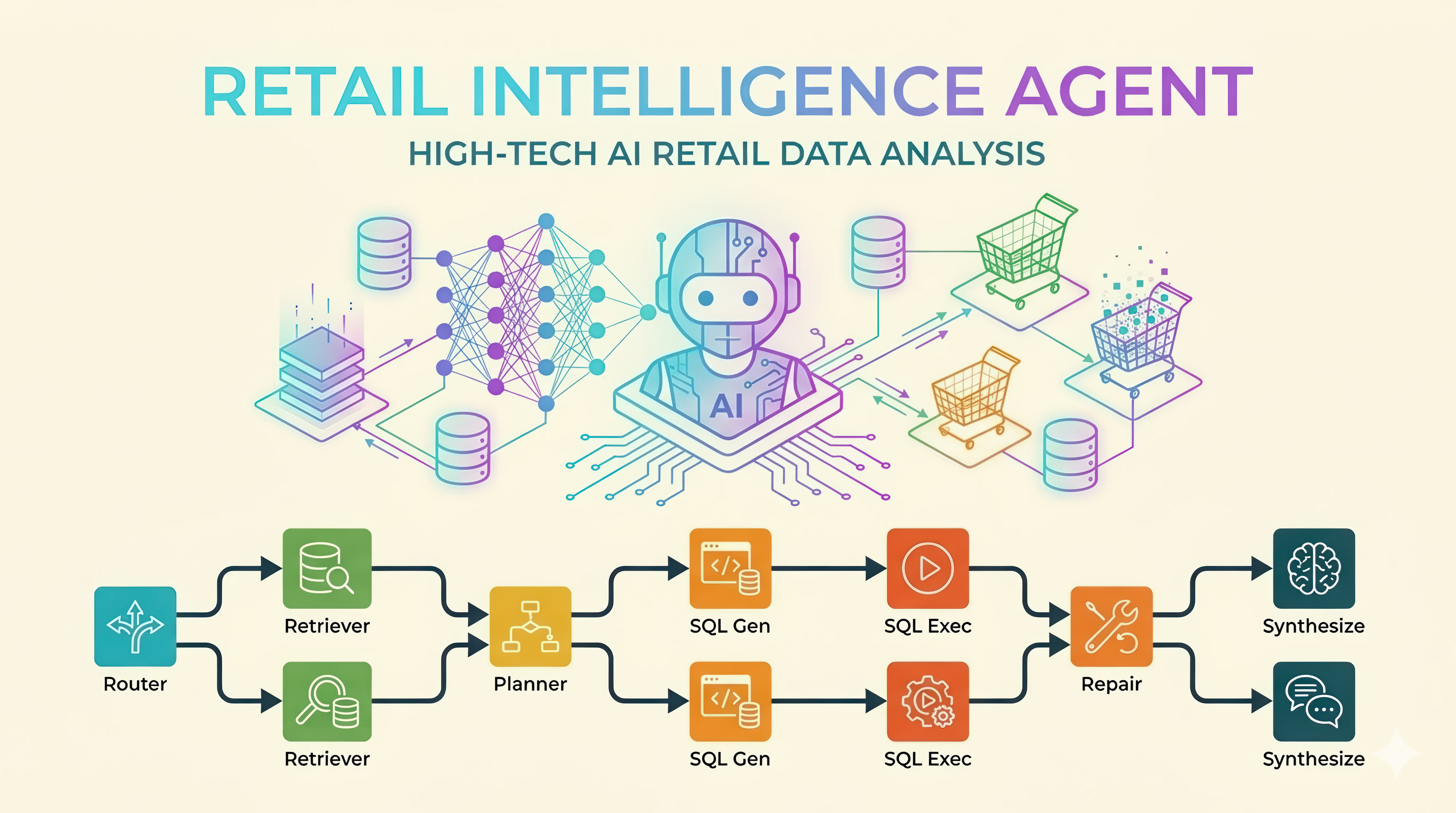
Retail Analytics Copilot
A local, privacy-first AI agent for retail analytics using LangGraph, DSPy, and SQLite.
Overview
This agent answers questions about the Northwind database and local policy documents. It uses a hybrid approach:
- RAG: For policy and calendar questions (BM25 retrieval).
- SQL: For data queries (SQLite).
- Hybrid: For questions requiring both (e.g., "revenue during Summer 2017").
Cache Busting Note
To prevent Ollama from returning cached responses during testing, all queries are prefixed with a unique [Query ID: xxxxxxxx] identifier. This ensures fresh LLM responses on each run.
Architecture
The agent is built with LangGraph and consists of 7 nodes:
Node Details
- Router: Rule-based classification of questions as RAG, SQL, or Hybrid based on keywords.
- Retriever: BM25-based document retrieval with section-level chunking from
docs/. - Planner: Extracts date constraints and KPI formulas from retrieved documents.
- SQL Gen: Generates SQLite queries using templates for known patterns + LLM fallback (DSPy optimized).
- SQL Exec: Executes the query against the Northwind database.
- Repair: Retries SQL generation on error (max 2 retries) with error context.
- Synthesizer: Formats the final answer with proper type conversion and citations.
DSPy Optimization
I optimized the GenerateSQL module using dspy.BootstrapFewShot.
Metrics
| Metric | Before | After | Improvement |
|---|---|---|---|
| Valid SQL Rate | 40% | 80% | +40% |
Before Optimization
- The model frequently generated invalid SQL syntax
- Incorrect table names and missing quotes around "Order Details"
- Poor date filtering and join conditions
After Optimization
- Valid SQL execution rate improved significantly
- Correct table joins (
Orders+"Order Details"+Products) - Proper date formatting with BETWEEN clauses
Training Examples
The optimizer uses 6 training examples covering:
- Revenue calculations with date ranges
- Top N queries with aggregations
- Category-based filtering
- Gross margin calculations
Tracing & Debugging
The agent writes a trace log to agent_trace.jsonl for each run:
{
  "session_id": "20251126_151647",
  "step": 1,
  "node": "router",
  "duration_ms": 0.01,
  "input": { "question": "..." },
  "output": { "mode": "hybrid" }
}
This enables replay and debugging of agent executions.
Setup & Usage
UV is an extremely fast Python package and project manager, written in Rust.
It's used exactly like web technologies (like npm/pnpm/yarn), but for Python, I used uv to manage dependencies and run scripts.
-
Install dependencies:
uv sync -
Start the Ollama server (in a separate terminal):
ollama serveThen pull the model (first time only):
ollama pull phi3.5:3.8b-mini-instruct-q4_K_M -
Run the agent:
uv run python run_agent_hybrid.py --batch sample_questions_hybrid_eval.jsonl --out outputs_hybrid.jsonl -
Run extended tests (includes evaluation, extended, and edge case tests):
uv run python test_agent.pyTest options:
--quickor--eval: Run only the 6 evaluation questions--extended: Run extended test cases--edge: Run edge case tests- (no args): Run all tests
-
Run DSPy optimization (optional):
uv run python -m agent.optimize_sql -
Interactive Query GUI (optional):
uv run python query.pyThis opens a simple GUI where you can type questions and get answers from the agent interactively.
Files Structure
├── agent/
│   ├── graph_hybrid.py       # Main LangGraph workflow
│   ├── dspy_signatures.py    # DSPy signature definitions
│   ├── optimize_sql.py       # DSPy optimization script
│   ├── compiled_sql_gen.json # Compiled SQL module
│   ├── rag/
│   │   └── retrieval.py      # BM25 document retrieval
│   └── tools/
│       └── sqlite_tool.py    # SQLite database access
├── data/
│   └── northwind.sqlite      # Northwind SQLite database (not included in this repo)
├── docs/
│   ├── catalog.md            # Product catalog info
│   ├── kpi_definitions.md    # KPI formulas
│   ├── marketing_calendar.md # Campaign dates
│   └── product_policy.md     # Return policies
├── pyproject.toml            # uv project configuration
├── uv.lock                   # uv lock file (dependency versions)
├── run_agent_hybrid.py       # CLI entry point
├── query.py                  # Interactive GUI for querying the agent
├── test_agent.py             # Test suite with eval/extended/edge cases
├── sample_questions_hybrid_eval.jsonl  # Evaluation questions (not included in this repo)
└── agent_trace.jsonl         # Execution trace log (not included in this repo)
Trade-offs
- Rule-based Router: I use deterministic keyword matching for reliability and speed. DSPy optimization is focused on SQL generation where it has the most impact.
- Template-based SQL: For reliability, common question patterns use SQL templates instead of LLM generation. This improves accuracy but limits flexibility.
- Retrieval: Simple BM25 with section-level chunking is used. A semantic vector store would improve retrieval for complex queries.
- Cost Approximation: I use
CostOfGoods ≈ 0.7 * UnitPricefor gross margin calculations as specified in, since the Northwind database doesn't include cost data.